Available 7 Days/Week       MON - FRI  8am - 7pm       SAT - SUN  10am – 6pm
Call us (407) 955-4575
Apply Now

Tag: #floridamortgage

FHA Mortgage Programs An FHA loan is a mortgage that is insured by the Federal Housing Administration. FHA loans usually have less rigorous lending standards and lower down-payment requirements, this makes FHA loans popular with first time home-buyers. FHA is an agency within the U.S. Department of Housing and Urban Development. Why a FHA loan Do you need less stringent qualification and credit requirements? Is your down payment less than 20%? Do you have less than perfect credit? FHA Minimum Property Requirements – see here FHA loan qualification requirements Credit scores as low as 620 may qualify Buy a home with as little as 3.5% down [ primary residence ] Debt to income ratio less than 5

FHA Mortgage Programs An FHA loan is a mortgage that is insured by the Federal Housing Administration. FHA loans usually have less rigorous lending standards and lower down-payment requirements, this makes FHA loans popular with first time home-buyers. FHA is an agency within the U.S. Department of Housing and Urban Development. Why a FHA loan Do you need less stringent qualification and credit requirements? Is your down payment less than 20%? Do you have less than perfect credit? FHA Minimum Property Requirements – see here FHA loan qualification requirements Credit scores as low as 620 may qualify Buy a home with as little as 3.5% down [ primary residence ] Debt to income ratio less than 55% 3 months of payment reserves required Loan amount must be under FHA Mortgage Limits [ check here ] #mortgagerates #fidelityhomegroup #fhaloan #fhamortgage ? original sound – Fidelity Home Group® – Fidelity Home Group®

#fidelityhomegroup, #floridamortgage, #floridamortgagerates, floridamortgagecalculator

Your interest rate and your APR are not the same number, and the gap between them is where broker fees, discount points and lender fees show up. Your interest rate is the cost of borrowing the principal loan amount. Your APR, or annual percentage rate, adds broker fees, discount points and other lender fees, also expressed as a percentage. That’s why your APR is often higher than your interest rate. Once you can read both numbers, the next step is choosing the mortgage type that fits you. Fixed-rate: the most common type. Your rate stays the same for the life of the loan, so your monthly payment won’t change, apart from property taxes, insurance premiums or homeowner’s association fees. Adju

Your interest rate and your APR are not the same number, and the gap between them is where broker fees, discount points and lender fees show up. Your interest rate is the cost of borrowing the principal loan amount. Your APR, or annual percentage rate, adds broker fees, discount points and other lender fees, also expressed as a percentage. That’s why your APR is often higher than your interest rate. Once you can read both numbers, the next step is choosing the mortgage type that fits you. Fixed-rate: the most common type. Your rate stays the same for the life of the loan, so your monthly payment won’t change, apart from property taxes, insurance premiums or homeowner’s association fees. Adjustable-rate (ARM): starts with an initial fixed-rate period, then the rate may change at preset intervals. Rates are generally lower to start, but they can rise, and you won’t be able to predict future monthly payments. Jumbo: a conventional loan above the conforming loan limit. For 2026, that limit is $832,750 for single-family homes in most of the U.S., according to the Federal Housing Finance Agency. Jumbo loans are more common in higher-cost areas and generally require more in-depth documentation to qualify. Government-insured: loans backed by the Federal Housing Administration (FHA), the U.S. Department of Agriculture (USDA) and the U.S. Department of Veterans Affairs (VA). The U.S. government sets the basic guidelines for each loan type, and private lenders offer the loans. Want to see your rate and APR side by side for your Florida home purchase? Call Fidelity Home Group at 407-955-4575 for a personalized mortgage rate quote ? #FloridaMortgage #MortgageRates #HomeBuying ? original sound – Fidelity Home Group® – undefined

#fidelityhomegroup, #floridamortgage, #floridamortgagerates, floridamortgagecalculator

Bank Statement Loans Self-employed? Your bank statements can qualify you for a mortgage. Self-Employed and Business Owners, as well as those who earn seasonal income, are finally starting to have access to excellent mortgage options. If your tax returns don’t show what you really earn, your real cash flow can prove your income instead. These mortgage products let you verify your income with bank statements. Tax returns, W2’s and pay stubs aren’t required. Bank Statement Mortgage Program Options: 12-month bank statements; qualify on Personal / Business Bank Statements up to 90% LTV (Loan to Value) 24-month bank statements; qualify on Personal / Business Bank Statements up to 90% LTV 12 Month

Bank Statement Loans Self-employed? Your bank statements can qualify you for a mortgage. Self-Employed and Business Owners, as well as those who earn seasonal income, are finally starting to have access to excellent mortgage options. If your tax returns don’t show what you really earn, your real cash flow can prove your income instead. These mortgage products let you verify your income with bank statements. Tax returns, W2’s and pay stubs aren’t required. Bank Statement Mortgage Program Options: 12-month bank statements; qualify on Personal / Business Bank Statements up to 90% LTV (Loan to Value) 24-month bank statements; qualify on Personal / Business Bank Statements up to 90% LTV 12 Month Bank Statement Program: Minimum 10% down payment with minimum 700 credit score for Primary Home only Minimum 20% down payment with minimum 660 credit score for Primary, Secondary and Investment Properties Cash-out Refinance up to 80% Loan to Value for Primary Residence Cash-out Refinance up to 70% Loan to Value for Second Homes and Investment Properties Rate Term Refinance up to 80% Loan to Value 2 years of self-employment history required Loans up to $5 million (minimum loan $200,000) Credit scores starting at 660 (no multi-family properties) No tax returns, pay stubs, W2’s or 4506T (the IRS tax transcript request form) required Debt to Income (DTI) up to 50% considered Primary, Secondary and Investment properties are eligible 5/1 ARM (adjustable-rate mortgage) or 30-year fixed terms available Property Types: Single Family, Town Homes, Condos, Non-Warrantable Condos, and Condotels No reserves required at 65% or less LTV Wondering how your bank statements could work for your next purchase or refinance? Call Fidelity Home Group at 407-955-4575 or visit https://www.fidelityhomegroup.com/bank-statement-mortgage/ ? original sound – Fidelity Home Group® – undefined

#fidelityhomegroup, #floridamortgage, #floridamortgagerates, floridamortgagecalculator

3 Housing Questions That Might Come Up at Your Next Family Dinner

3 Housing Questions That Might Come Up at Your Next Family Dinner Simplifying The Market

This time of year usually means more time spent with family and friends. And in recent years, when everyone gets together, the conversation has a way of drifting to housing.

Your uncle is sure home prices are about to crash. Your cousin heard foreclosures are surging. And someone across the table brings up the word “recession.”

If you’ve wondered about any of this yourself, that makes sense. There’s a lot of noise out there. So let’s look at what the data actually shows, so you’ll have real answers the next time it comes up.

“Are Home Prices Going To Crash?”

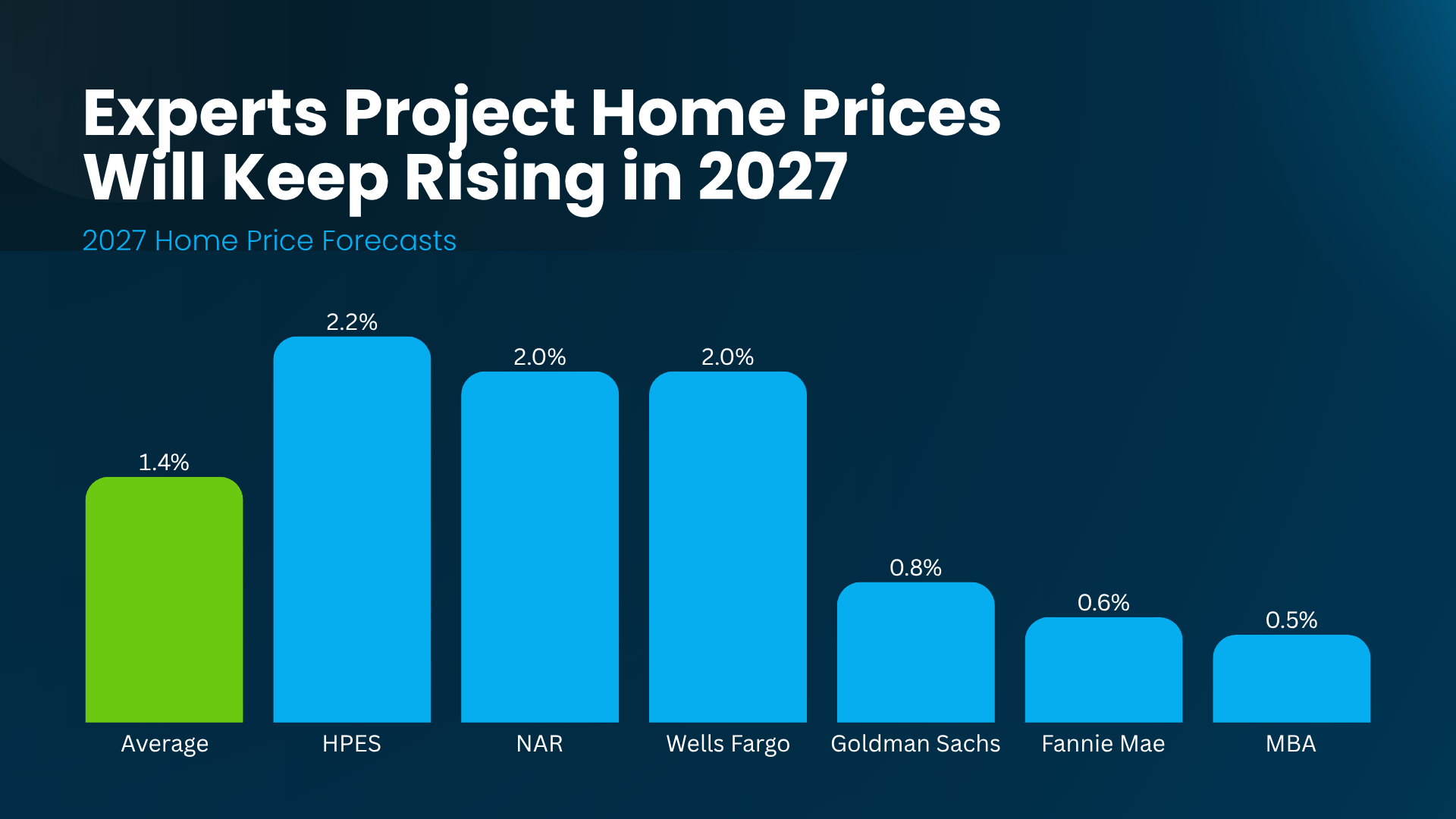
Let’s start with your uncle’s crash prediction. The short answer is no. Experts project home prices will keep climbing nationally in 2027. 

On average, forecasters expect prices to rise about 1.4% next year (see graph below). That’s slower than the big jumps of a few years ago, but it’s still growth, not a crash.

a graph of blue rectangles with white text

Prices are dipping in some markets, though. It just depends on where you live. Lawrence Yun, Chief Economist at the National Association of Realtors (NAR), explains why:

“Price declines are occurring mainly in southern states, where there has been robust new home construction in recent years. Given the region’s faster job growth, these price drops should be viewed as temporary and as a second-chance opportunity for those previously priced out of the market.”

So, the dips that are fueling all the social media chatter are limited to select areas, and experts think they’ll be short-lived. It doesn’t mean a crash is looming. 

If you’re thinking about moving, look at the numbers for your area.

“Is This 2008 All Over Again?”

Then your cousin chimes in about foreclosures. They’ve ticked up lately, but here’s some important context. That’s compared to very low levels. They’re still below where they were before the pandemic, according to ATTOM.

So, why doesn’t today look like 2008? Logan Mohtashami, Lead Analyst at HousingWire, explains:

“. . . we have had many recessions post-WWII but only one foreclosure crisis. That foreclosure crisis started with a massive credit boom from 2002-2005, and then a credit bust. . . none of that is happening now . . .“

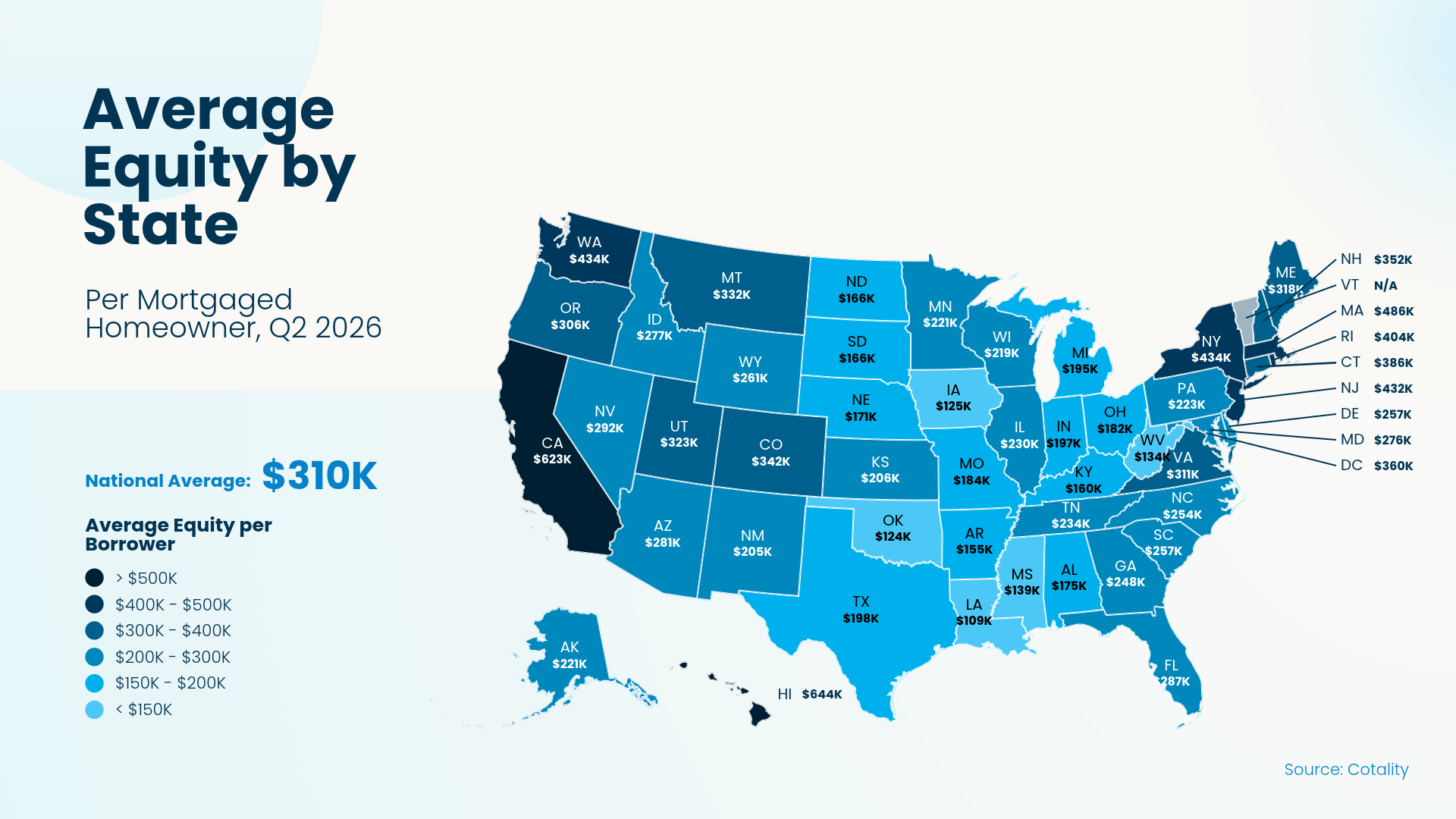
Today’s homeowners also have something a lot of people didn’t have back then – equity. In every state, the average homeowner with a mortgage has more than $100,000 of it, according to Cotality (see map below):

a map of the united states

If a homeowner hits a rough patch, they can usually sell their house instead of facing foreclosure.

“Are We Headed for a Recession?”

While someone in your family may be convinced a recession is coming, experts don’t agree. The average forecast from The Wall Street Journal’s survey of economists puts the odds at about 24%, so most experts aren’t expecting one. And that’s a good thing.

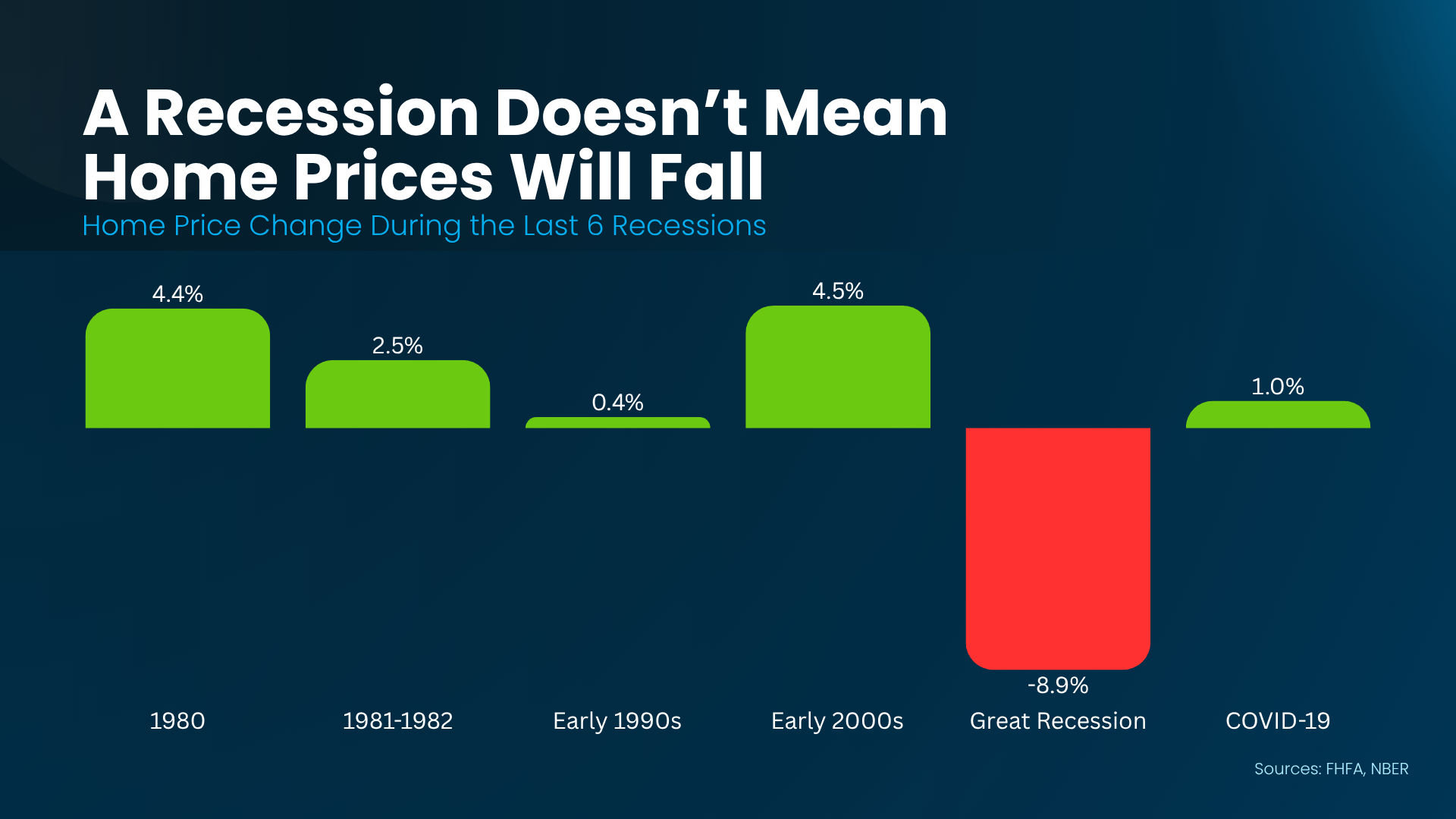
But even if one hits, history shows a recession doesn’t mean home prices will automatically fall. In 5 of the last 6 recessions, prices actually went up, according to the Federal Housing Finance Agency (FHFA) (see graph below):

a graph of a graph showing the price of a fall

The one exception was 2008, the only one of these recessions that started in the housing market itself.

Bottom Line

So, the next time your uncle predicts a crash or your cousin brings up 2008, you’ll know prices aren’t crashing, foreclosures are still low, and a recession doesn’t automatically spell trouble for housing. 

If a move in 2027 is on your mind, connect with a local real estate agent to look at what prices are doing in your neighborhood so you can plan with real local numbers, not scary headlines.

#fidelityhomegroup, #floridamortgage, #floridamortgagerates, #mortgageflorida

A Fixer-Upper Could Be Your Path To Homeownership

A Fixer-Upper Could Be Your Path To Homeownership Simplifying The Market

When the homes you love keep landing outside your budget, it may be time to look at the ones other buyers skip.

A fixer-upper won’t be the right call for everyone. Plenty of buyers want a home that’s ready on move-in day. But homes that need some updating could get you in the door for a lot less. 

More buyers are starting to realize it too. And Danielle Hale, Chief Economist at Realtor.com, explains why:

“Fixer-uppers give buyers a way to break into the housing market at a time when affordability is still stretched thin. For those with the vision. . . fixer-uppers provide both a starting point in the market and the chance to create a home that’s truly their own.”

If that sounds like you, here’s why a fixer-upper could be worth a closer look.

The Price Tag Is Usually Lower

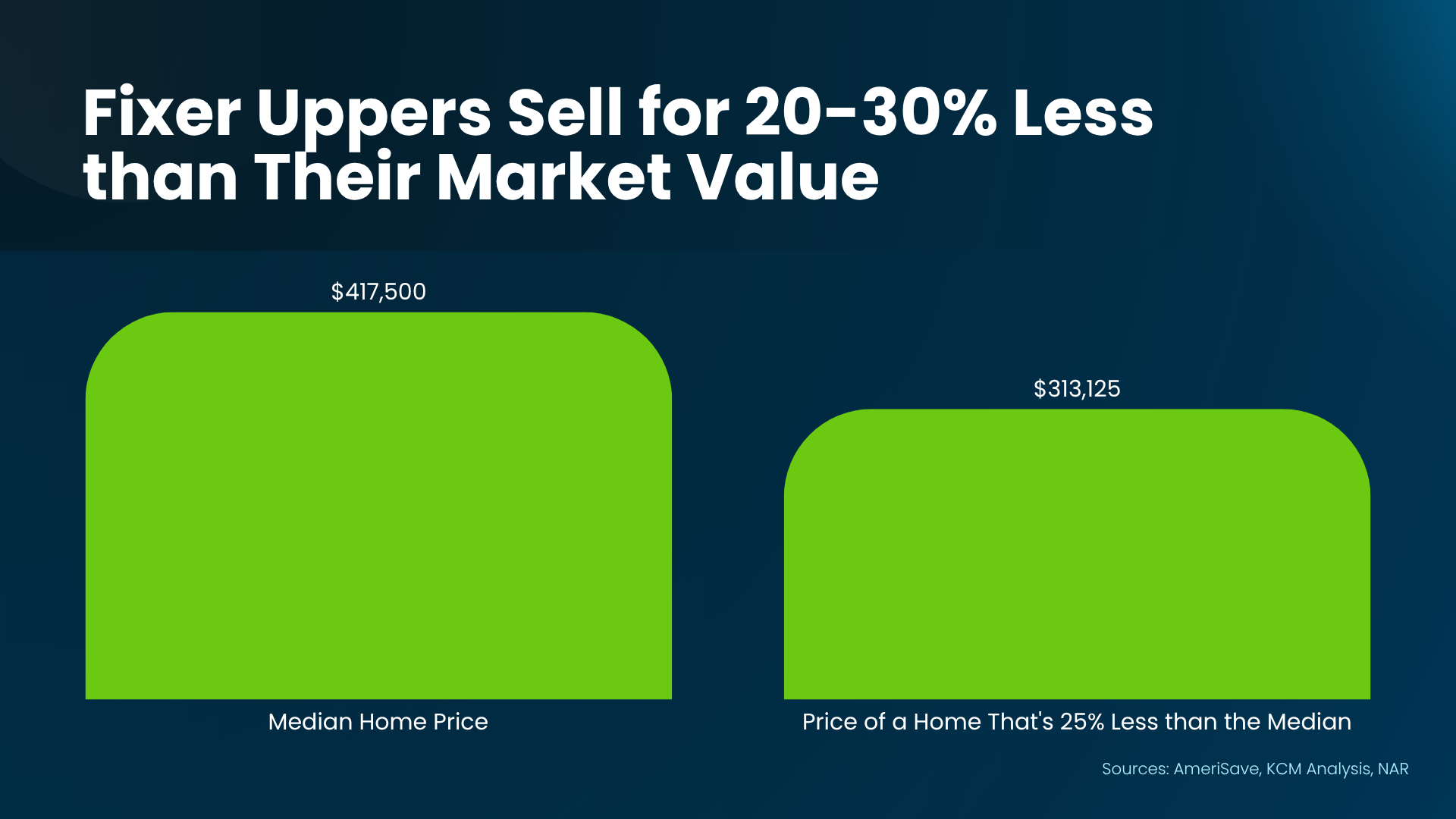
Because these homes need work, they tend to have a lower asking price up front. According to AmeriSave, fixer-uppers usually sell for 20% to 30% less than what they’re worth on the market.

Here’s what that could look like. KCM applied a 25% discount – the middle of that range – to the median home price from the National Association of Realtors (NAR). This is an example, not the average price of a fixer-upper. But it shows the savings could top $100,000 (see graph below):

a green rectangles with white text

That’s a big difference up front and it could be what gets you into a home today. And odds are you don’t have to tackle all the repairs at once – you can space them out over time as it works for you.

Just remember repair costs can add up quickly and eat into those savings if you don’t plan ahead. So, before you make an offer, get estimates from a contractor and set a repair budget you’re comfortable with. There are even some loan types designed to help pay for the work.

One Loan Can Cover the Home and the Repairs

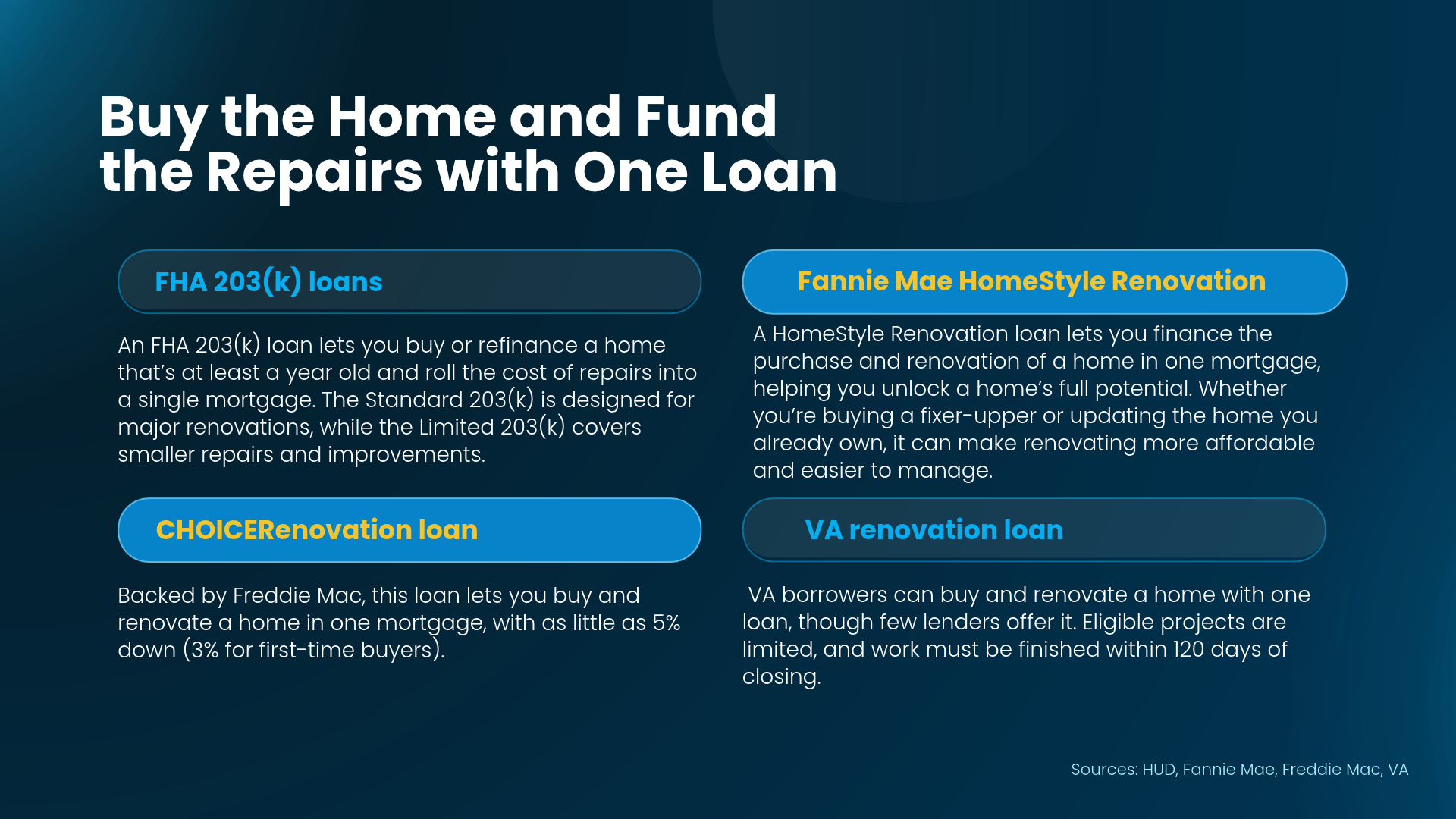
With a renovation loan, you can roll the cost of the work into your mortgage, so you don’t have to cover it all out of pocket once you move in. Here are a few options from FHA, Fannie Mae, Freddie Mac, and the VA (see visual below):

a screenshot of a home loan application

Each program has its own rules, and not every lender offers all of them. So, talk to a trusted lender to see which options are available to you and which make sense for how you plan to tackle updates and repairs over time.

Don’t Overlook Local Perks

Some cities even offer tax breaks to buyers who renovate a fixer-upper and raise its value. These programs vary by location, so check with your city or a tax professional to see what’s available where you want to live.

If you want to check for more information yourself, go to your local county or city official dot-gov website. Then, use the search bar and look for: [City or County Name] AND “home rehabilitation” OR “property tax incentive” OR “housing repair”

A local agent can also help you find fixer-uppers in the neighborhoods you have your heart set on.

Bottom Line

If move-in-ready homes keep coming in over budget, a home that needs some TLC could be your way in. Plan your repair budget and line up the right loan before you buy, and you can get in the door now and make the space your own over time, as your budget allows.

Connect with a local agent to start looking at fixer-uppers in the neighborhoods you love.

#fidelityhomegroup, #floridamortgage, #floridamortgagerates, #mortgageflorida

Before you fall for a listing, know the four numbers lenders actually look at. Key Factors Lenders Look At • Gross Monthly Income: Your pre-tax earnings. • Debt-to-Income (DTI) Ratio: Lenders typically use the 28/36 rule (spending no more than 28% of gross income on housing or 36% on total debt, though some loans stretch to 43%–50%). • Credit Score: Minimum scores vary by loan type: ? Conventional: 620 preferred (3%–20%+ down). ? FHA: 580 minimum (or 500 with a 10% down payment; standard is 3.5%). ? VA / USDA: 0% down options available for eligible buyers. • Down Payment & Closing Costs: Typically 3% to 20% down, plus 3% to 6% in closing costs. To find out how much house you can afford, revi

Before you fall for a listing, know the four numbers lenders actually look at. Key Factors Lenders Look At • Gross Monthly Income: Your pre-tax earnings. • Debt-to-Income (DTI) Ratio: Lenders typically use the 28/36 rule (spending no more than 28% of gross income on housing or 36% on total debt, though some loans stretch to 43%–50%). • Credit Score: Minimum scores vary by loan type: ? Conventional: 620 preferred (3%–20%+ down). ? FHA: 580 minimum (or 500 with a 10% down payment; standard is 3.5%). ? VA / USDA: 0% down options available for eligible buyers. • Down Payment & Closing Costs: Typically 3% to 20% down, plus 3% to 6% in closing costs. To find out how much house you can afford, review your options with us using the Fidelity Bank Mortgage Qualifier. ? Link in bio Prefer to talk it through? Call us at 407-955-4575. #FloridaMortgage #HomeBuying #FirstTimeHomeBuyer ? original sound – Fidelity Home Group® – undefined

#fidelityhomegroup, #floridamortgage, #floridamortgagerates, floridamortgagecalculator

Know the difference between interest rate vs. annual percentage rate, APR. It’s easy to confuse a mortgage interest rate and APR, but they’re quite different. The interest rate is the cost of borrowing money for the principal loan amount. It can be variable or fixed, but it’s always expressed as a percentage. An APR (annual percentage rate) includes the mortgage interest rate plus other costs such as broker fees, discount points and other lender fees, expressed as a percentage. APR is often higher than your interest rate.Get your mortgage rate quote with no personal information required – https://www.fidelityhomegroup.com/mortgage-rate-quote/ #mortgagerates #mortgageratequote #fidelityhomeg

Know the difference between interest rate vs. annual percentage rate, APR. It’s easy to confuse a mortgage interest rate and APR, but they’re quite different. The interest rate is the cost of borrowing money for the principal loan amount. It can be variable or fixed, but it’s always expressed as a percentage. An APR (annual percentage rate) includes the mortgage interest rate plus other costs such as broker fees, discount points and other lender fees, expressed as a percentage. APR is often higher than your interest rate.Get your mortgage rate quote with no personal information required – https://www.fidelityhomegroup.com/mortgage-rate-quote/ #mortgagerates #mortgageratequote #fidelityhomegroup ? original sound – Fidelity Home Group® – Fidelity Home Group®

#fidelityhomegroup, #floridamortgage, #floridamortgagerates, floridamortgagecalculator

Planning To Sell in 2027? Start Prepping Now.

Planning To Sell in 2027? Start Prepping Now. Simplifying The Market

If selling your house is on your calendar for 2027, you may be thinking you’ve got plenty of time. Maybe you’re aiming for January. Maybe you’re waiting for spring. Either way, next year probably feels far enough away that getting ready can wait, too. 

But waiting until 2027 to sell doesn’t mean waiting until 2027 to get started.

Today’s buyers have more homes to choose from than they’ve had in years. So, if you want your house to stand out when it’s time to list, a little preparation now can make a big difference later.

How Early Should You Start Getting Ready?

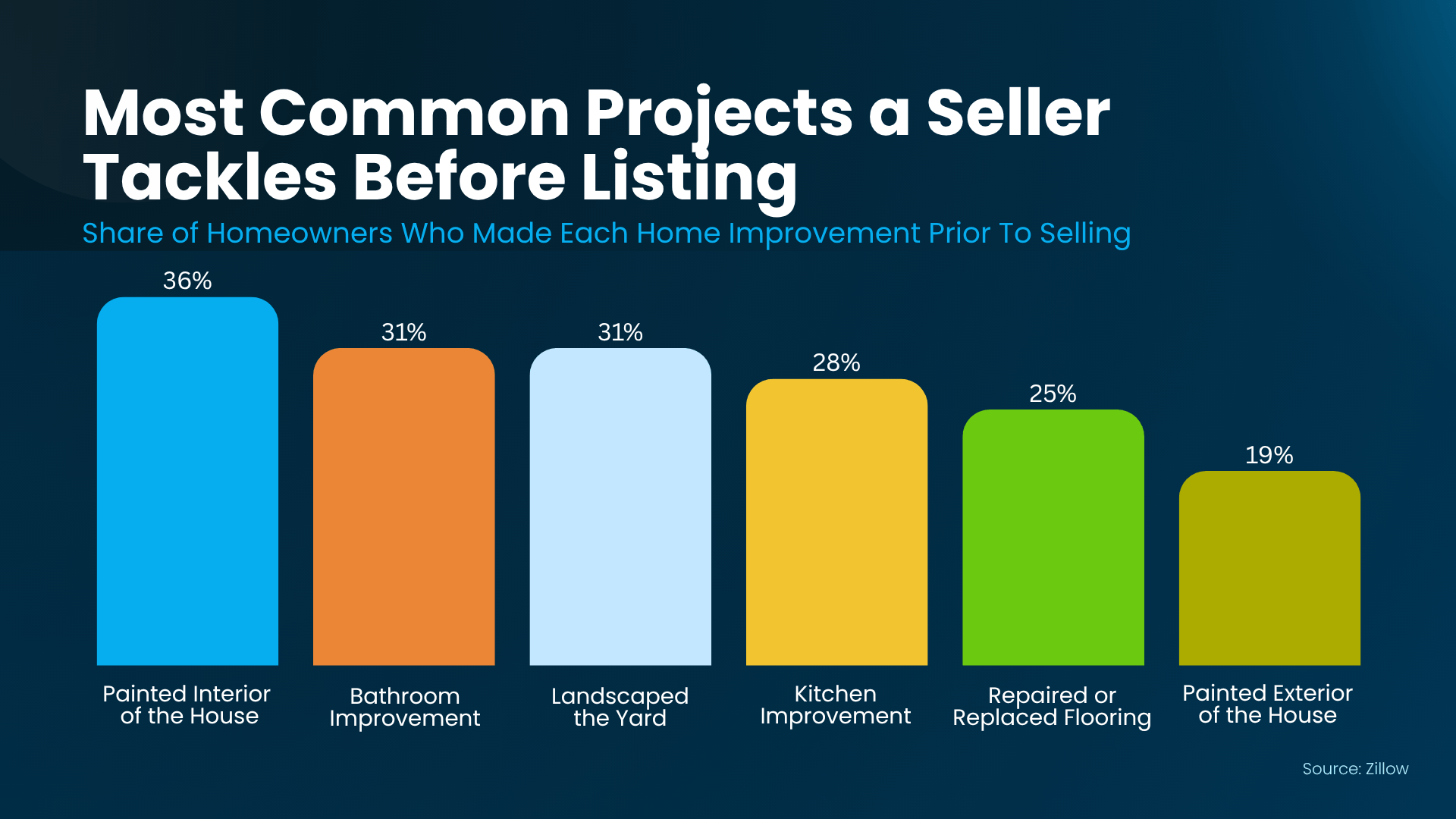
As a general rule of thumb, Zillow recommends giving yourself about 2-3 months to get your house ready to list. And that makes sense when you consider that the vast majority of sellers (78%) did at least one home improvement project before their house hit the market. 

That gives you plenty of time to decide what to fix, find contractors, get on their schedules, actually make the updates, and get everything ready for photos and showings. 

But don’t worry – that doesn’t mean every seller had some big to-do. The most common? Interior painting (see graph below):
a graph of a number of colored rectangles

That certainly doesn’t mean you need to tackle everything on this list. You may not need to do any of it. But odds are there’s at least one project you’ll want to do. And starting that conversation now gives you a leg up before next year. 

Here’s how to tackle it.

1. Talk to an Agent Before Starting Any Projects

While you might have a long list of things you think need updating, that doesn’t mean they’re all worth the time, effort, or money. 

An agent will help you figure out which projects deserve a spot on your to-do list based on what buyers want most and what other sellers are doing. That way, you’re not investing in updates that won’t make much of a difference when you sell.

2. Get Ahead with a Pre-Listing Inspection

One thing your agent may recommend today is that you go ahead and get a pre-listing inspection. It’s basically your cheatsheet to what a buyer’s inspection may turn up later on. 

And now that buyers have more options, they’re pickier – and you don’t want anything popping up in an inspection that could put them off.

For example, you know that HVAC system you’ve been hoping will make it through one more season? Now’s a good time to give it some attention – along with anything else you know needs a little TLC. That way a repair you could’ve handled months ago won’t become a surprise in the middle of your sale. 

According to Angi, a pre-listing inspection typically costs $300-600 and that can be money well spent. As the National Association of Realtors (NAR) explains:

“An inspector will be able to give you a good indication of the trouble areas that will stand out to potential buyers, and you’ll be able to make repairs before open houses begin.”

The advantage isn’t just knowing what may come up, but being able to get ahead of it and space out the projects on your own schedule. So you don’t feel stressed during go-time. 

3. Save the Final Touches for Closer to Listing Day

But remember, not everything needs to happen right away. Some things are better saved for when you’re closer to listing.

Think deep cleaning, staging, touching up paint, and tidying up the landscaping. Those are the finishing touches that’ll help your house look its best when buyers walk through the door.

But there’s one thing you can start anytime: decluttering. Go ahead and tackle the closets, garage, or storage room you’ve been avoiding. Future you will appreciate having a few less boxes to pack.

The idea isn’t to get everything done today. It’s to spread the work out so you’re not scrambling when listing day arrives. As Redfin puts it:

“Smart preparation leads to a smoother sale, stronger offers, and fewer surprises during closing. . . Homes that are clean, well-staged, priced right, and professionally photographed tend to sell quickly.”

Bottom Line

You don’t need to spend the rest of the year renovating your house or packing up your life. But you can start making a plan.

The earlier you figure out what needs to be done, the more time you’ll have to do it right. And that means less rushing, fewer last-minute surprises, and a better chance to make a great first impression when you’re ready to sell.

Thinking about selling in 2027? Get a local agent’s opinion on what your house needs, what it doesn’t, and how to get everything ready on your timeline.

#fidelityhomegroup, #floridamortgage, #floridamortgagerates, #mortgageflorida

Florida Home Equity Loan Programs Have a mortgage with a low rate and don’t want to refinance? We offer two home equity solutions: a Home Equity Loan (HELOAN) and a Home Equity Line of Credit (HELOC). Both let you borrow against your home’s built-up equity, up to 90% of your home’s value. A HELOC is a flexible line of credit based on your home’s equity. You borrow as much or as little as you need, up to your approved limit. During the draw period, which typically lasts several years, you access funds as needed. When that period ends, you repay the amount you borrowed plus interest. A HELOAN gives you a one-time lump sum for a set loan amount, with a fixed interest rate and predictable monthl

Florida Home Equity Loan Programs Have a mortgage with a low rate and don’t want to refinance? We offer two home equity solutions: a Home Equity Loan (HELOAN) and a Home Equity Line of Credit (HELOC). Both let you borrow against your home’s built-up equity, up to 90% of your home’s value. A HELOC is a flexible line of credit based on your home’s equity. You borrow as much or as little as you need, up to your approved limit. During the draw period, which typically lasts several years, you access funds as needed. When that period ends, you repay the amount you borrowed plus interest. A HELOAN gives you a one-time lump sum for a set loan amount, with a fixed interest rate and predictable monthly payments for the full term. Florida home equity loan requirements: a minimum credit score of 640, a maximum debt-to-income (DTI) ratio of 50%, up to 90% loan-to-value or combined loan-to-value (LTV/CLTV), and loan amounts up to $500,000. Loan terms run from 5 to 30 years, with options featuring 10 years of interest-only payments. Eligible property types include single-family homes, condos and townhomes. Minimum documentation: income documents, homeowner’s insurance, your mortgage statement (if applicable) and a photo ID. In most scenarios, an AVM (Automated Value Model) and exterior drive-by appraisals are used to keep costs down and speed up closing. Closings can happen in as little as 20 days, and there’s no prepayment penalty. A HELOAN or HELOC can be used for nearly any purpose, including college tuition, large purchases, renovations and debt consolidation. Since your home secures the loan, it’s important to borrow wisely and manage repayment carefully. Wondering which option fits your situation? Call us at 407-955-4575 or learn more at https://www.fidelityhomegroup.com/home-equity-loans/ #FloridaHomeEquity #HELOC #FloridaMortgage ? Ok I Like It – Milky Chance

#fidelityhomegroup, #floridamortgage, #floridamortgagerates, floridamortgagecalculator